
The Labyrinth
Threshold, Descent, Return
Sometimes the way forward is inward. Sometimes the only way out is through.
The labyrinth is a path that winds toward a center and back out again. Its winding corridors invite us to loosen our grip on the destination and surrender to a journey whose meaning may not become clear until we have walked it. A true labyrinth is unicursal, with one path, no dead ends, and no wrong turns. A maze is built to confuse and has many choices. A labyrinth asks only that you keep walking. The maze belongs to the thinking mind, while the labyrinth works on the body and the heart.
We may lose sight of where we are going, but we have not necessarily lost our way.
Walk The Path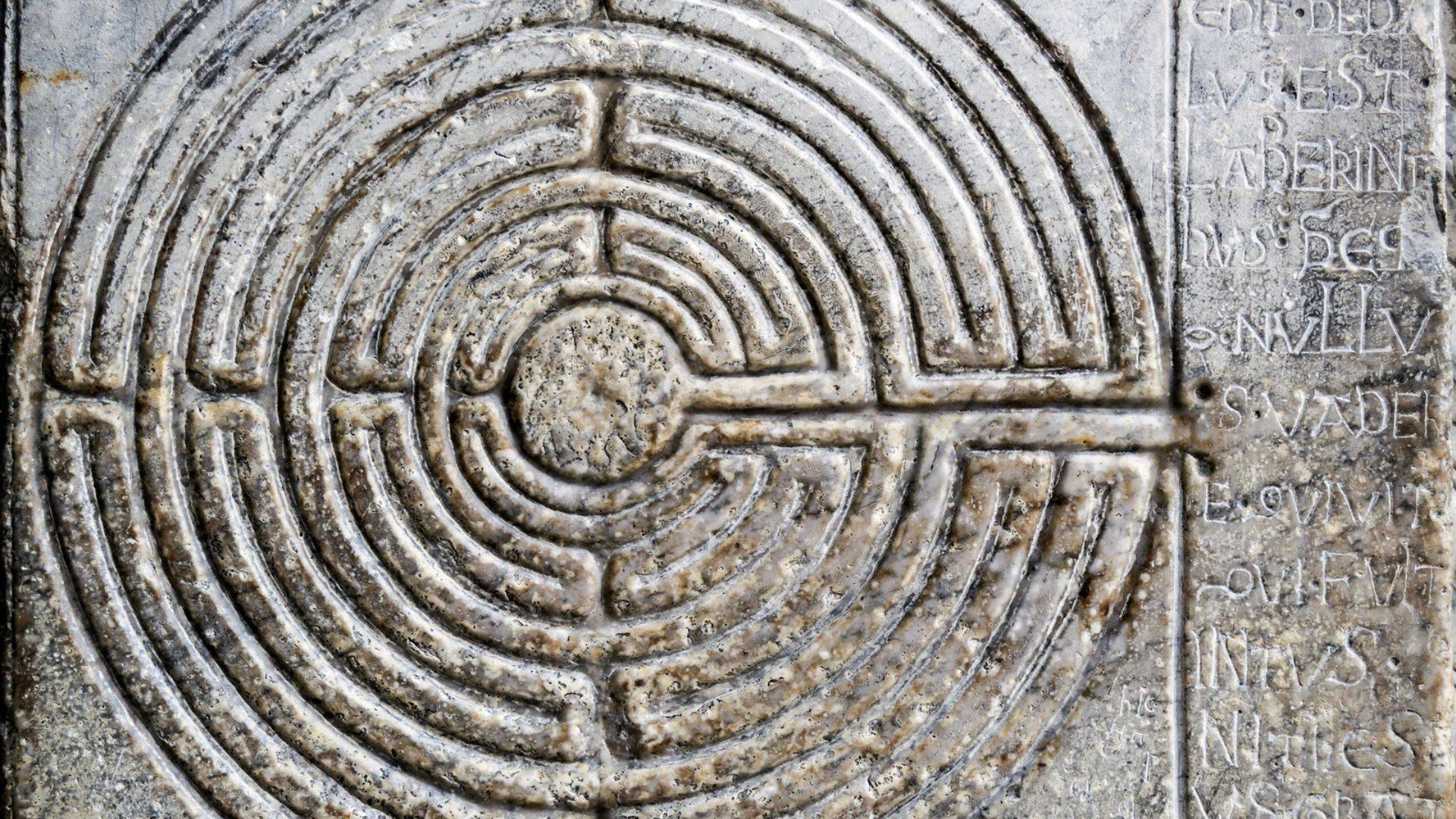
Symbol
An ancient architecture of mystery
The labyrinth is among humanity's enduring symbolic forms, appearing in ancient art, architecture, mythology, and sacred landscapes. Labyrinthine patterns have been found across multiple cultures, though their meanings and uses have varied. Some have served as decorative motifs, others as ritual spaces, and still others as paths for contemplation or symbolic pilgrimage.
One of the best-known forms is the classical seven-circuit labyrinth. Later medieval European cathedrals developed elaborate labyrinths, including the celebrated example at Chartres Cathedral in France. These floor labyrinths became associated with Christian pilgrimage and devotional practice.
Although the labyrinth appears across cultures, it is important not to assume that every example shares one universal origin or meaning. Its power lies partly in the way different peoples and generations have encountered the same compelling form.
Story
Theseus, Ariadne & the Minotaur
Perhaps the most famous labyrinthine story comes from ancient Greek mythology, where the labyrinth becomes the setting for a confrontation with the monstrous, the unknown, and the parts of ourselves we would rather not face.
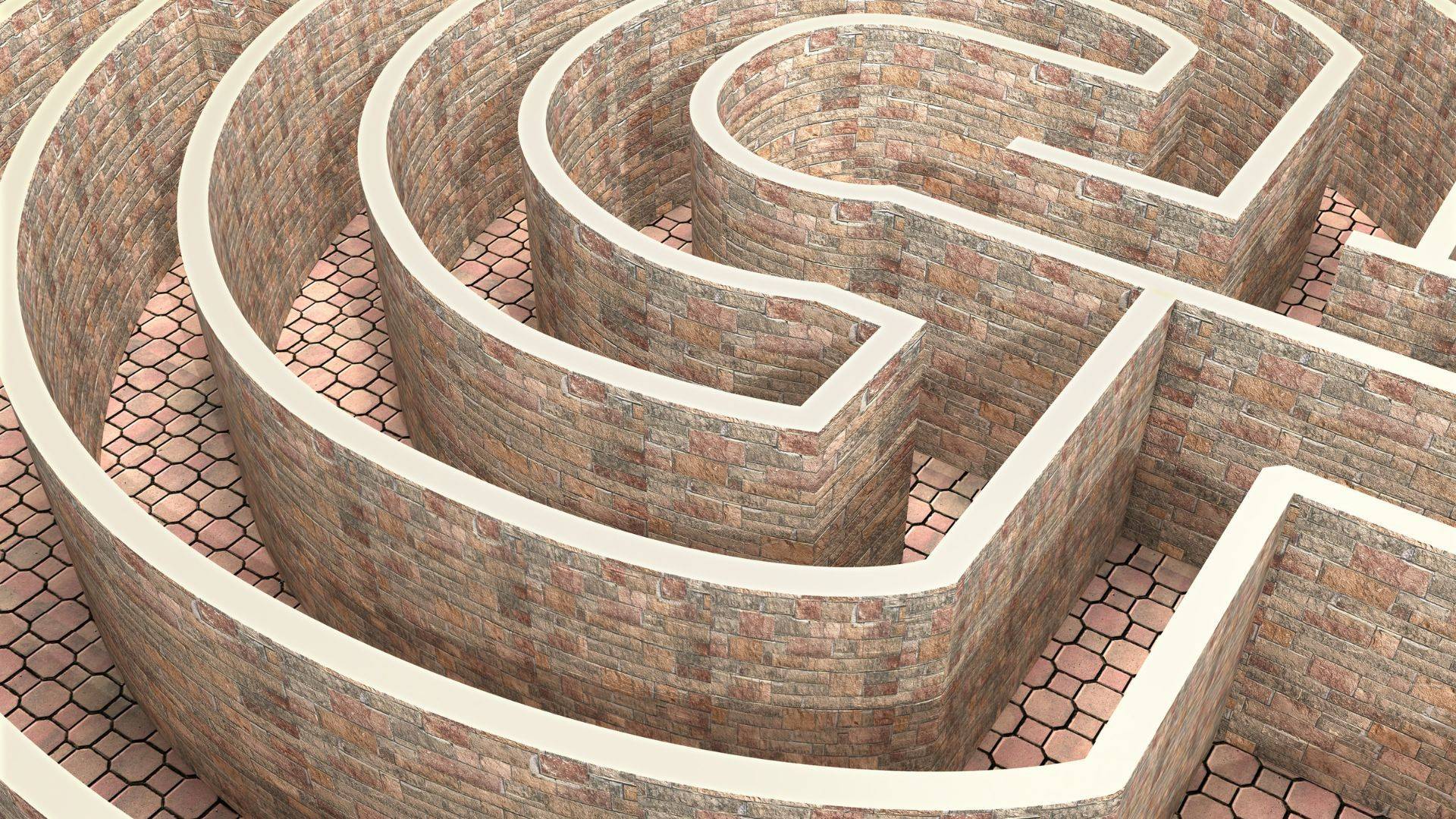
King Minos of Crete commissions a master craftsman to construct an elaborate labyrinth to contain the Minotaur, a creature with the body of a man and the head of a bull. Hidden within its winding corridors, the Minotaur becomes both prisoner and threat.
When the Athenian hero Theseus enters the labyrinth to slay the creature, he carries a crucial tool: a thread given to him by Ariadne, the daughter of Minos. By unwinding the thread as he travels inward, Theseus creates a way to retrace his steps and escape.
He confronts and kills the Minotaur, then follows the thread back out.
................
Reading between the threads
The labyrinth as the unconscious
The labyrinth may be read as a metaphor for the unconscious: an intricate inner world that cannot be mapped entirely from the surface. Entering it means approaching the material we cannot resolve through conscious reasoning alone.
The Minotaur as the shadow
In a depth-psychological reading, the Minotaur might represent the shadow: the impulses, wounds, fears, and disowned qualities we have learned to hide. The creature is monstrous in the eyes of the story's world, but it is also imprisoned. We might ask not only what makes it dangerous, but what created the conditions of its captivity.
What we refuse to acknowledge does not necessarily disappear. It may instead influence our choices from the hidden corridors of the psyche.
Ariadne's thread as inner knowing
Ariadne supplies the means of return. Her contribution invites us to reconsider the hero's journey: transformation rarely happens through individual willpower alone. We need connection, intuition, discernment, and resources that help us remain oriented when familiar landmarks disappear.
Ariadne's role also raises a question about whose wisdom makes the hero's triumph possible, and whose contribution is forgotten when the story is retold.
The return as integration
Slaying the Minotaur is not the whole journey. The hero must leave the labyrinth.
In psychological terms, insight is not the same as integration. Recognizing a pattern, naming a wound, or encountering a hidden part of ourselves is only the beginning. We must learn how to live differently with what we now understand.
The labyrinth remains, but you are no longer entering it as the same person.
Soma
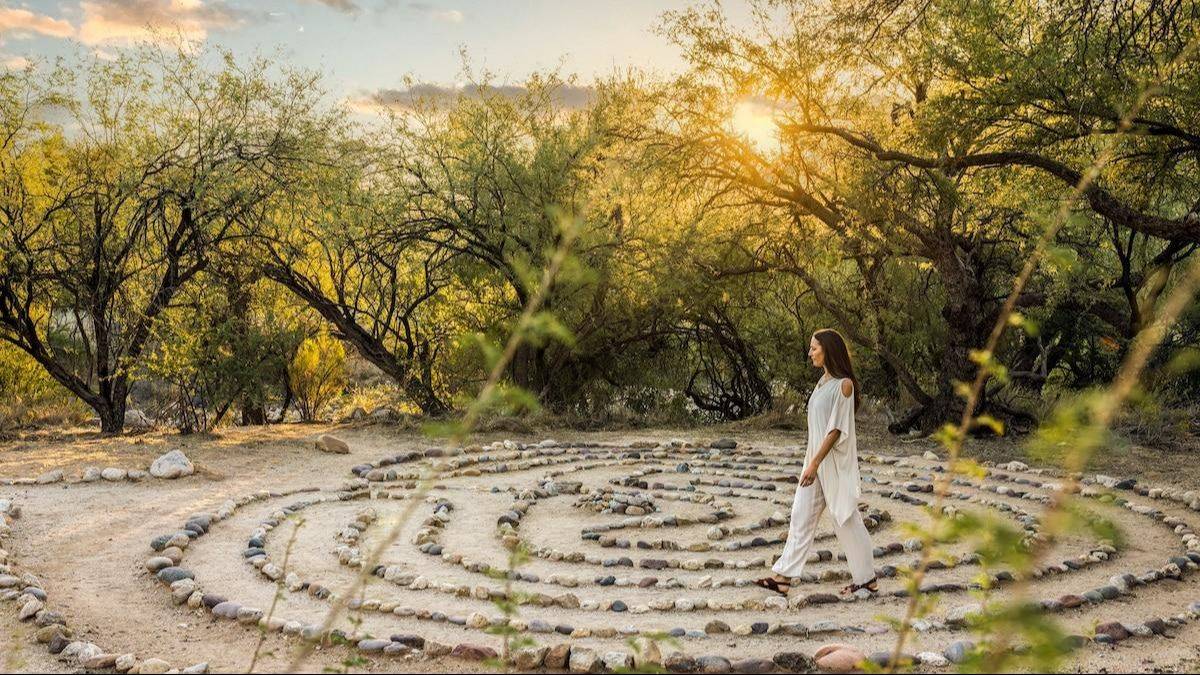
Embodied practice: Walking the Labyrinth
There is no correct sensation to produce and no special state you need to achieve. The practice is an invitation to notice your own experience with curiosity rather than force.
The Threshold | Arrive
👣 Pause before entering. Feel your feet against the ground. Name the question, transition, or intention you are bringing with you.
🌀Do you feel curiosity, anticipation, resistance, or uncertainty? What happens when you take the first step?
The Descent | Follow
👣 Walk slowly. Let the path determine your direction rather than anticipating every turn. When your mind races ahead, return your attention to the sensation of one foot in front of the other.
🌀Can you remain present when the route turns away from your intended direction? Where do you notice impatience or the desire to take control?
The Center | Listen
👣 When you reach the center, pause. Allow yourself to be still. Notice what is present without demanding a revelation or a particular emotional response.
🌀What happens when you stop moving? Does stillness feel nourishing, uncomfortable, vulnerable, or unfamiliar? Allow thoughts, sensations, images or silence to arise as you feel into what may want your attention right now.
The Return | Integrate
👣 Follow the path outward. Notice the world around you. Consider what, if anything, you want to carry into your everyday life.
🌀Does the outward journey feel different from the inward one? What has shifted, even if the physical path remains unchanged?
Beyond the walking path
The labyrinth can also become a metaphor for working with the patterns that repeat throughout our lives.
In relationships, we may return to familiar conflicts. In grief, we may circle between acceptance and longing. In personal growth, we may encounter the same fear after believing we have already moved beyond it.
Instead of interpreting every return as failure, we can ask whether we are encountering the pattern differently this time.
Embodiment helps us bring this inquiry out of abstraction. We can notice where a familiar pattern appears in our posture, breath, impulses, and habitual responses. We can practice pausing long enough to choose something different.
The aim is not to romanticize suffering or suggest that every difficult experience happens for a reason. It is to cultivate a more conscious relationship with the paths we find ourselves walking.
💭Where in your life might you benefit from less forcing and more attentive participation?